CHAPTER 1 OF 3
Chapter 1: The Wrong Skyline
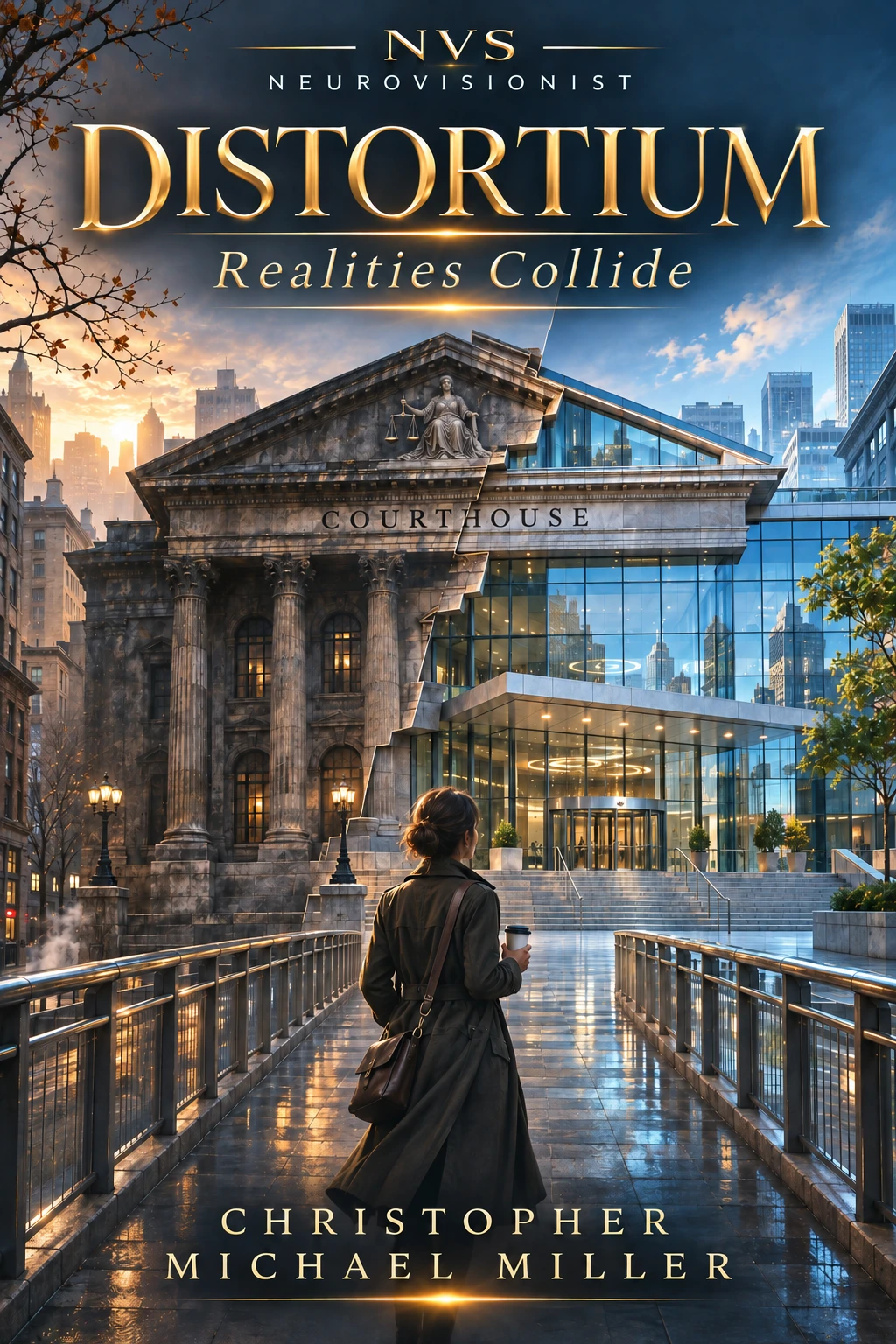
At 8:17 on a Tuesday morning, the courthouse moved three feet to the left.
Mara Venn saw it from the pedestrian bridge over Mercer Avenue. One moment the old stone building stood where it had stood since she was a child, wedged between the Meridian tower and the blue church steeple. The next, it had slid sideways without shaking the ground or disturbing the pigeons along its roof. Its western wall passed through the corner of a parking garage. For a fraction of a second, two courthouses occupied the same place: one with soot-darkened stone and narrow windows, the other with a glass entrance added during the renovation twenty-three years earlier.
Then the older face vanished. The renovated courthouse settled back into the morning.
Mara’s paper cup folded in her hand. Coffee ran over her thumb. Below, a bus stopped in the intersection. A cyclist swore at a crack in the road that had not been there a breath before. People stood looking upward, their faces lifted toward an ordinary skyline. A woman near the bridge stairs held her phone out as if it might tell her what she had seen.
“Did you get that?” someone asked.
No one answered. A horn sounded, then another. Traffic moved again, cautiously at first, then with the impatient certainty of a city that had decided it would rather be late than frightened.
Mara wiped coffee from her hand. Her phone vibrated against her coat.
STILL ON FOR TONIGHT? her brother had written.
She typed: I think the courthouse moved.
She read the sentence, imagined Eli calling before she reached work, and deleted it. Their mother had been dead four years, and since then Eli had built a careful life around making sure Mara was all right. He did it with groceries, dinner invitations, and questions that sounded casual until she tried not to answer. She loved him for it. She also hated giving him another reason to worry.
The Institute of Applied Geometry stood six blocks from the bridge, behind a limestone facade designed to look like a tax office. Mara arrived with wet cuffs and the taste of burnt coffee in her mouth. At the lobby desk, security guard Hales glanced up from his monitor.
“Long morning?” he asked.
“Did you see downtown?”
“Traffic?”
“The courthouse.”
He considered her face, then his screen. “I saw people stop walking.”
The elevators carried her below the street, past the public research floors and into the basement that did not appear on the building map. Her badge opened the first door. A palm scan opened the second. The third was already ajar.
Inside the observation bay, Dr. Ivo Saye stood before a wall of frozen sensor feeds. He had taken off his jacket and rolled his sleeves to the elbows. The displays painted his face in pale blue bands.
“You felt it?” he asked.
“Everyone felt something.”
“Not everyone remembers.”
Mara set down her ruined coffee. “What does that mean?”
Ivo turned one monitor toward her. At 8:17:03, the array’s power draw had risen for four thousandths of a second. No test had been scheduled. No operator had authorized a startup. Yet the laser grid’s survey of downtown showed two sets of coordinates layered over each other: the current courthouse and the building beneath it, before the renovation.
The Disruptor Array occupied the next room, silent behind a curved glass wall. Six silver vanes surrounded a hollow sphere, each blade etched with calibration marks so fine they looked like scratches. Mara had helped design the first stable ring, years before the Institute had given it a name. The proposal described an experiment in local geometry: persuade a bounded region of space to take a different shape for less than a second.
In the lab, they called it a rewrite. In public, they called it a measurement device.
She leaned toward the monitor. “The array wasn’t active.”
“No.”
“Then why is its signature in the city scan?”
“I was hoping you’d tell me.”
A dark circle sat at the center of the data, precisely where no instrument had been installed. Thin marks crossed its edge at irregular intervals. Mara felt a sudden chill beneath her collar.
She knew those marks. She had drawn them in the margin of a student notebook, in the winter after her mother’s first diagnosis. They described a boundary that could be interrupted without being broken: a way to let two neighboring structures touch and then separate cleanly. The work had been rejected as mathematically elegant and physically useless. She had kept the notebook. She had never given the Institute the page.
“That pattern was never built,” she said.
Ivo enlarged the circle. “Apparently, it found another route.”
Mara looked through the glass at the motionless vanes. “Show me the access history.”
“Already did. Nothing.”
“Nothing isn’t an access history.”
“It is when every log says the same thing.”
She opened the archive on her terminal. The earliest copy of her model sat in a folder marked REJECTED, attached to a proposal she had written before joining the Institute. The file had been opened months earlier and copied into the array’s control architecture. Its timing intervals had been changed. Its safety limiters had been removed.
Someone had taken the idea she abandoned and made it operational.
The lights dimmed. In the array chamber, one of the silver vanes turned a few degrees. The movement was small, but the motor assembly was disconnected. No current reached the ring.
A metallic note passed through the floor.
Ivo stepped back from the glass. “That’s new.”
On the display, the dark circle widened. For a blink, a second map of the Institute appeared inside the first. In the other map, the observation bay had a window overlooking a courtyard. A woman stood in that courtyard wearing a red coat.
Mara knew the coat. She had seen it in photographs, hanging from the kitchen door at home, bright against the narrow hall. Her mother had worn it on the day she took Mara and Eli to the river, before either child understood that a good day could become a memory without warning.
The second map disappeared.
Mara stared at her own reflection in the glass. Behind it, the array’s vanes were still.
“Did you see…” Ivo began.
“Yes.”
“What was it?”
“An overlap.” She kept her voice steady by making it small. “The system found a local structure that matched the boundary model. It set the two arrangements on top of one another.”
“Without a trigger.”
“Without one we can see.”
The elevator sounded beyond the corridor. Footsteps approached. Mara closed the archive window, though the copied file remained in her mind: the missing safeguards, the changed intervals, the little spaces where the original design had said stop.
Mara moved to the access console and held her badge against the reader. The archive opened, then refused her request to export the altered file. A red banner said the record was under executive review. She tried the original project directory. It had been locked too. Someone had anticipated that she would look.
“Who placed the hold?” she asked.
Ivo checked the permissions. “Director’s office.”
“Before or after the courthouse event?”
He looked at the time stamp. “Seven minutes before.”
The answer settled over them. The downtown shift might have been an accident, but the silence around it was not. Mara copied the visible screen to her personal drive. It was only a picture, barely evidence, but it preserved the strange ring and the unauthorized timing. She could feel her pulse in her burned thumb. On the other side of the glass, the silver vanes held perfectly still.
“Someone knew this might happen,” she said.
Ivo did not answer. His silence told her he had reached the same conclusion and was deciding how much of it he could safely say aloud.
A door opened behind them. Director Vale entered with two people from federal oversight. His charcoal suit looked untouched by the morning. He did not look toward the array before turning to Mara.
“Dr. Venn,” he said. “We need your credentials and all copies of the original model.”
“Why?”
“The project is suspended pending review.”
“Then show me the activation log.”
Vale’s expression barely changed. “You are not in a position to make demands.”
“I’m the person who wrote the boundary model. Someone changed it and loaded it into the control system.”
One of the oversight officers glanced at Vale. The other began taking notes.
“You designed this machine,” Vale said.
“I designed a mathematical model. I did not approve a live system.”
The word system seemed to irritate him more than machine would have. “No one here is building a weapon.”
A glass wall behind Vale turned briefly opaque. When it cleared, his reflection stood half a step behind him, wearing the same suit and a thin scar across one cheek. The real Vale had no scar.
Mara turned. The wall showed only the room.
Ivo looked down at the sensor display. “Two heartbeats,” he whispered.
The array gave another soft, metallic note. This time it seemed to come from somewhere under Mara’s feet.
CHAPTER 2 OF 3
Chapter 2: The Disruptor
The oversight officers took Mara’s badge but did not ask for her phone. She kept it in her pocket and kept the screen capture of the altered design on its memory. It was the only copy she knew they had not already locked away.
Director Vale gave the order in a voice that made it sound like a courtesy. “You’ll remain available for questions. Until the review is complete, you are not to enter the lower facility or contact anyone assigned to the array.”
“Am I under investigation?” Mara asked.
“You’re a designer whose work has appeared in a system you say you never approved.”
“That isn’t an answer.”
“It’s the one I have.” He turned to the two officers. “Escort Dr. Venn to the lobby.”
Mara looked at Ivo. His face had gone still in the way it did when he was thinking through several risks at once. “Send me the event trace,” she said.
Vale answered for him. “No internal data leaves this building.”
An Institute security officer stepped between them. He was broad-shouldered and close-cropped. “Dr. Venn, please come with us.”
One of the federal officers watched Ivo. Mara understood the arrangement: if they made a scene, the machine would remain behind with the people who had changed it. She set her hands at her sides and walked toward the door.
In the corridor, the guard introduced himself as Ren Okafor. “I’m assigned to facility security,” he said. “The federal team has authority to restrict access, but I need your statement about the display.”
“You saw it?”
“I saw two heartbeats in one place.”
“Then you saw the display.”
“I saw what it recorded. I don’t know what it means.”
“Neither do I.”
Ren looked at her as they passed the locked elevator. “You said someone changed your model. Can you show me?”
“They took my badge.”
“You have a copy?”
“Not the file.” She tapped her pocket. “A screenshot.”
They stopped beside a fire door while the officers continued toward the lobby. Ren held out a hand but did not ask for the phone. “Tell me first. What does the machine do?”
Mara chose words that would still make sense if she had to repeat them to a room of lawyers. “Space has local structure. A room has walls, distances, history. The array can interrupt those rules in a small region and let a second arrangement overlap the first. If the structures are nearly identical, the change may look like a wall appearing where a doorway used to be. If they’re not, the region can’t settle.”
“Like replacing one room with another?”
“Like making both rooms occupy the same coordinates and forcing them to compete. We thought the overlap would collapse as soon as the pulse ended.”
“And it didn’t.”
“The courthouse returned. That doesn’t mean the effect ended.”
Ren rubbed his thumb along the seam of his badge. “What would make it last?”
“Power. Repetition. An anchor.”
“What kind of anchor?”
“A place, object, or memory that exists in both versions strongly enough for the system to line them up. The original design treated anchors as calibration references. They were never meant to choose which version survived.”
Ren looked back toward the observation bay. “Could a person be an anchor?”
Mara thought of the red coat in the courtyard. “I don’t know.”
His earpiece crackled. He listened, said nothing, then led her through a side passage instead of toward the lobby. “Vale wants you out of the building. The federal officers can do that in a minute. Before they do, I need to know whether the array can run without its control console.”
“The vanes moved without current.”
“That isn’t what I asked.”
“No. The geometry is in the control architecture. If someone has a remote trigger or a second power source, the room could activate from outside the bay.”
“Do you know where that source is?”
“Not yet.”
Ren unlocked a small security office. Inside, a bank of camera monitors showed corridors, loading docks, and the sealed laboratory door. One camera displayed an empty hall. Another showed a technician pushing a cart. In the third, the cart moved through the hall with nobody pushing it.
Ren enlarged the image. “That camera was stable ten seconds ago.”
“Which version is it showing?”
“I don’t know.”
“Save the feed.”
He tried. A message appeared: RECORDING UNAVAILABLE, SOURCE NOT FOUND. The time stamp advanced while the picture remained fixed.
Mara pulled out her phone and showed him the screen capture. Her old model appeared beside the altered control pattern. The safety limiters were not merely missing. Someone had replaced the stop condition with a feedback loop. Each pulse measured the boundary and used the measurement to strengthen the next one.
“They made it learn the overlap,” Ren said.
“They made it hold on.”
“Who could change the control code?”
“Vale, the systems group, and anyone with the project key.”
“Can you prove which one?”
“Not from the screenshot.”
Ren opened a drawer and removed a paper access roster. “I can prove who entered the control floor this morning.”
The list showed Vale’s credential at 7:52. A second entry appeared under an anonymous service account at 8:10. The account had never been assigned to a person. Mara photographed the page.
Her phone buzzed. A news alert announced a temporary transit closure near Mercer Avenue because of “road-surface irregularities.” Beneath it was a short clip filmed from the street: the courthouse facade bending sideways, the old stone windows glowing through the newer glass.
Mara replayed it. At the edge of the frame, a man in a gray suit turned toward the camera. The image broke into blocks before his face came into focus.
“Do you recognize him?” Ren asked.
“No.”
“Could it be Vale?”
“In the reflection there were two of him.”
Ren turned off the monitor wall. “We need Saye.”
They found Ivo in the records alcove, his access disabled and his laptop closed. He slipped a small data card into Mara’s palm as the escort officers came down the hall.
“Raw trace,” he murmured. “Not the summary.”
The officers reached for his laptop. Ren stepped forward, claiming custody of both researchers under an internal safety protocol. The argument bought them only a minute, but a minute was enough to reach the loading dock.
Outside, the autumn air smelled of exhaust and wet stone. Ren’s car was parked beneath a camera that had turned to face the wall. He opened the passenger door.
Mara looked once at the Institute. Somewhere below them, the array had moved without power. Somewhere above, the city was pretending that nothing had happened.
“Where are we going?” she asked.
“To a place with no network connection.”
“I know one.”
“Your brother’s?”
“No. He has too many windows.”
Ivo slid into the back seat. “The old transit station under the river terminal. Its signal repeaters were removed when the line closed.”
Ren started the car. “Then we’ll go there.”
As they pulled away, Mara checked the screenshot again. The pattern she had drawn as a student looked almost delicate on the small screen. The altered feedback loop around it looked like a knot pulled tight.
A new notification appeared, though she had no service. Unknown sender. One sentence: The room is listening.
The screen dimmed. A second message arrived, this one carrying a string of numbers and letters that looked like a file address. Ivo leaned over from the back seat. “That’s a local path. It can’t have come through the network.”
“Could it be queued?” Ren asked.
“Not if the phone is offline.” Ivo read the address twice. “It points to an archive folder at the Institute. A directory that was deleted three years ago.”
Mara took a screenshot. “Can you open it?”
“Not from here. It may be a route, or it may be bait.”
Ren checked the rearview mirror. The street behind them was clear, but his shoulders stayed tight. “We are not going back to the Institute until we know what it is.”
The address vanished from the screen. The image of the altered model remained in Mara’s camera roll. She zoomed in on the stop condition, the line that should have cut the feedback loop after a single pulse. Someone had crossed it out, then written a replacement in a notation she did not recognize. It looked almost like her own hand, though the final stroke bent the wrong way.
For years she had told herself the old model was harmless because it had never left her notebook. Now it had become a machine, and the machine seemed to know where she lived. She wondered whether the design had been copied by a person, or whether each event was drawing the old equations into the world by itself. She could not tell which answer frightened her more.
She showed it to Ren. He did not ask her to explain. He drove faster.
CHAPTER 3 OF 3
Chapter 3: Two Versions of Eli
The old transit station smelled of damp concrete and metal dust. Ren parked behind a shuttered ticket office, and they descended a stairwell that ended at a platform where no train had run in eleven years. A single emergency lamp made a small island of light. Beyond it, the tiled tunnel disappeared into black.
Ivo set his laptop on a bench and inserted the data card. “The trace is intact,” he said. “The public summary was edited.”
“Can you tell where the first pulse came from?” Mara asked.
“Not yet. But the event at the courthouse wasn’t the first.” He opened a sequence of timestamps. “The array registered tiny disturbances over the last six weeks. A room on level four. The loading dock. A bridge outside the city. Each one lasted less than a millisecond.”
“Were they tests?” Ren asked.
“Some. Maybe all. The records say the array was inactive.”
Mara leaned over the screen. Each disturbance carried a location tag and a second line of data that looked like a pulse pattern. She recognized the spacing from her old notebook. “These are anchors.”
“Coordinates?”
“Not physical. The array is collecting references that can line up with another version of a place. It’s learning what stays recognizable when the structure changes.”
Ivo scrolled through the samples. “This one has a biological rhythm.”
Ren’s hand went to the radio clipped at his belt. “Person?”
“Possibly.”
“Can you trace it?”
“To an address.” Ivo highlighted a coordinate. Mara felt her stomach tighten. It was Eli’s apartment building.
She was already reaching for her coat.
Ren caught her wrist. “If the array is tracking you through him, walking in without a plan makes the problem worse.”
“I’m not leaving him alone in there.”
“Then let’s make a plan on the way.”
They drove to Eli’s building with the station’s dark tunnels still in their clothes. Ren parked across the street and studied the windows. Mara called her brother. It rang twice, then went to voicemail. She sent a message: Coming by. Open the door.
No response.
The lobby smelled of lemon cleaner. The elevator was out, so they climbed six flights. At the top, Mara saw that Eli’s doormat had shifted to the right. It was a small thing, the sort of detail she would have ignored yesterday. Now she checked the hallway number. 6B. Correct.
She knocked.
Eli opened the door with a dish towel over one shoulder. “You look like somebody told you the moon has a supervisor.”
“Can we come in?”
He glanced at Ren and Ivo, then moved aside. “That bad?”
His apartment was warm, crowded with books and half-finished projects. A pan sat on the stove. Coffee had burned at the bottom of a small pot. On the shelf beside the kitchen was a photograph of the three of them at the beach: their mother holding a paper umbrella, Eli squinting into the sun, Mara making a face because sand had got inside her shoes.
The sight steadied her. “Do you remember that day?”
“Mom made us walk to the car barefoot,” Eli said. “She thought sand in the car was worse than sand on our feet.”
“She was wrong.”
“She was confident.”
Mara lifted the photograph. Their mother’s smile looked slightly different from the one in her memory, wider, with a crease at one corner of her mouth. She closed her eyes and the beach came back in fragments: hot boards underfoot, a towel snapping in the wind, Eli running toward the water. Then a second memory pushed forward. Rain on the windshield. Their mother in a red coat. Eli, much younger, asleep in the back seat.
Mara set the frame down.
“What happened?” Eli asked.
“I remembered another day.”
“Another beach day?”
“I don’t know.”
Her phone vibrated. An unknown number had sent a video file. No message, no caller information. She looked at Ren. He nodded once. Ivo opened his laptop and began recording the screen.
Mara pressed play.
Their mother’s kitchen filled the display: yellow wallpaper, old cabinets, a ceramic bowl with a crack down its side. Their mother stood at the counter, younger than she had been at the hospital and older than she had looked in the beach photograph. She turned toward the camera.
“Mara,” she said. “If the room changes, don’t follow the version that asks you to forget.”
The clip ended.
Eli had gone pale. “That was Mom.”
“It looked like her.”
“It was her.” He reached for the phone, stopped himself. “Where did you get this?”
“I don’t know.”
“Show me again.”
She replayed it. His eyes fixed on their mother’s face. The second time, he listened for something she had missed: a breath before the sentence, the faint click of a cabinet door, the sound of a spoon set down beyond the edge of the image.
“She was making tea,” he said. “She always tapped the spoon twice.”
Mara had not heard the taps. When they replayed the video a third time, a quiet double click sounded under the last word.
The phone rang.
The caller ID read ELI.
Mara turned toward her brother. His own phone lay on the table, screen dark. The ringing continued in her hand.
“Don’t answer,” Eli said.
A voice came through the speaker anyway. “Mara? It’s Eli. I need you to get out of there.”
The Eli in the kitchen stared at the phone as if it had begun to breathe.
Ren moved between Mara and the apartment door. Ivo shut his laptop. The sound on the call came again, close and strained. “She’s using the room. You have to go.”
Mara looked from one brother to the other. The man beside the stove had Eli’s tired eyes and a small white scar at his chin, left by a bicycle fall when he was thirteen. The voice in the phone had the same low rasp he got when he was afraid.
“Tell me something only you would know,” she said.
The man in the room answered first. “The hospital. Mom’s blue sweater. You spilled tea on the blanket.”
That was true. It was also a story he had heard from her more than once.
The voice from the phone said, “She made me wait in the hallway when the doctor told her the treatments had stopped working. You came out and said she wanted us both in the room. She told you not to carry everything alone.”
Mara forgot to breathe. That last sentence was not something she had told Eli. Their mother had spoken it to Mara while Eli was getting coffee. She had kept it to herself because it felt too private to make into a family story.
The man by the stove looked wounded. “Mara, I was there.”
“Not for that,” she whispered.
The photograph on the shelf changed. In one version, their mother held the paper umbrella. In the other, her hands were empty and she wore the red coat. The two pictures flickered, each one replacing the other too quickly for the eye to settle.
Eli reached toward Mara. She stepped back.
“Which one of you remembers the ferry?” she asked.
The man beside the stove blinked. “What ferry?”
The voice on the phone answered. “The one we missed because Mom stopped to watch the gulls steal somebody’s lunch.”
A laugh escaped Mara, sharp and frightened. “That was us.”
“Both versions can remember things,” Ivo said. “The anchor isn’t proof of identity.”
The room gave a small, wet shudder. For an instant, water covered the kitchen floor, reflecting a second ceiling. The Eli by the stove blurred at the edges. The call dropped. The photograph snapped back to the beach, paper umbrella intact.
Mara grabbed Ren’s sleeve. “We have to get out.”
Eli stood very still. “Which of you is leaving?”
Mara could not answer. She took the old brass key from the shelf, the one their mother had kept for the garden shed, and placed it in Eli’s palm. “Hold on to something that’s yours.”
The walls rippled. A narrow door appeared beside the apartment entrance, though the hallway beyond it should have been solid brick. From the other side came their mother’s voice, saying Mara’s name.
Eli closed his fingers around the key. “That’s not her.”
“I know.”
But she did not know. That was the worst part. The voice could belong to a memory, to another living woman, to a trick in the machinery, or to something neither of them had a word for. Each possibility opened a different door.
Ren pulled the fire alarm. Its bell rang through the building, forcing the neighbors to open their doors and step into the hall. The new door vanished in the sudden crowd of people, leaving only brick and peeling paint. Ren guided Mara and Ivo down the stairs. Eli came with them, still holding the brass key.
Outside, the street looked ordinary. He stood beside Mara under the awning, breathing hard.
“You have to tell me what’s going on,” he said.
“I will.”
“Don’t protect me by lying.”
“I’m not.” She looked at his face, searching for a certainty the machine had taken away. “I saw two versions of you. I don’t know which one was on the phone.”
Eli studied her for a long moment. “The one who called knew what Mom said.”
“Yes.”
“And the one in the room knew the rest of my life.”
“Yes.”
“Then we don’t decide from one memory.” He looked down at the key. “We find out what the machine is doing, and we make sure it doesn’t get to choose for us.”
The streetlight above them blinked, though it was still afternoon. Across the road, a shop window reflected the four of them. In the glass, their mother stood behind Mara in her red coat.
This time, Mara did not turn toward the reflection. She kept her eyes on Eli and took his hand.
You’ve reached the end of the sample.
This preview contains chapters 1–3 from the current review manuscript. The complete edition is not on sale in this website preview.
DISCOVER ANOTHER STORY →